What “lyophilized” means
Lyophilization is freeze-drying. The peptide is dissolved in water, frozen solid, then placed under vacuum so the ice sublimates directly to vapor without ever becoming liquid again. What’s left is a dry, fluffy white powder — the same peptide molecule, just with the water removed.
Why peptides ship this way: dry peptide is far more stable than dissolved peptide. Water is the medium for most chemical degradation reactions, so removing it slows degradation by orders of magnitude. The pellet you see at the bottom of a sealed peptide vial is lyophilized peptide; reconstitution (adding BAC water or saline) brings it back into solution.
Storing the unreconstituted (lyophilized) vial
Lyophilized peptide powder is shelf-stable for months to years if stored correctly. The narrow version of correctly:
| Storage condition | Range | Practical shelf life |
|---|---|---|
| Freezer (long-term) | −20°C to −80°C (−4°F to −112°F) | 2+ years for most peptides |
| Refrigerator (default) | 2°C to 8°C (35°F to 46°F) | 12–24 months |
| Room temperature | 15°C to 25°C (59°F to 77°F) | Weeks to a few months — depends heavily on the peptide. Acceptable for short-term shipping; not ideal for long-term storage. |
| Above 30°C / 86°F | Avoid | Accelerated degradation. Don’t leave peptides in a hot car or near a window. |
Default recommendation: refrigerator (2–8°C). Standard household fridge is fine. Keep the original vials in the back of the fridge, away from the door (where temperatures fluctuate when you open it).
Long-term holding (rare for typical users): freezer at −20°C. Useful if you bought several vials at once and only plan to reconstitute one every few months.
Light and heat — the two enemies
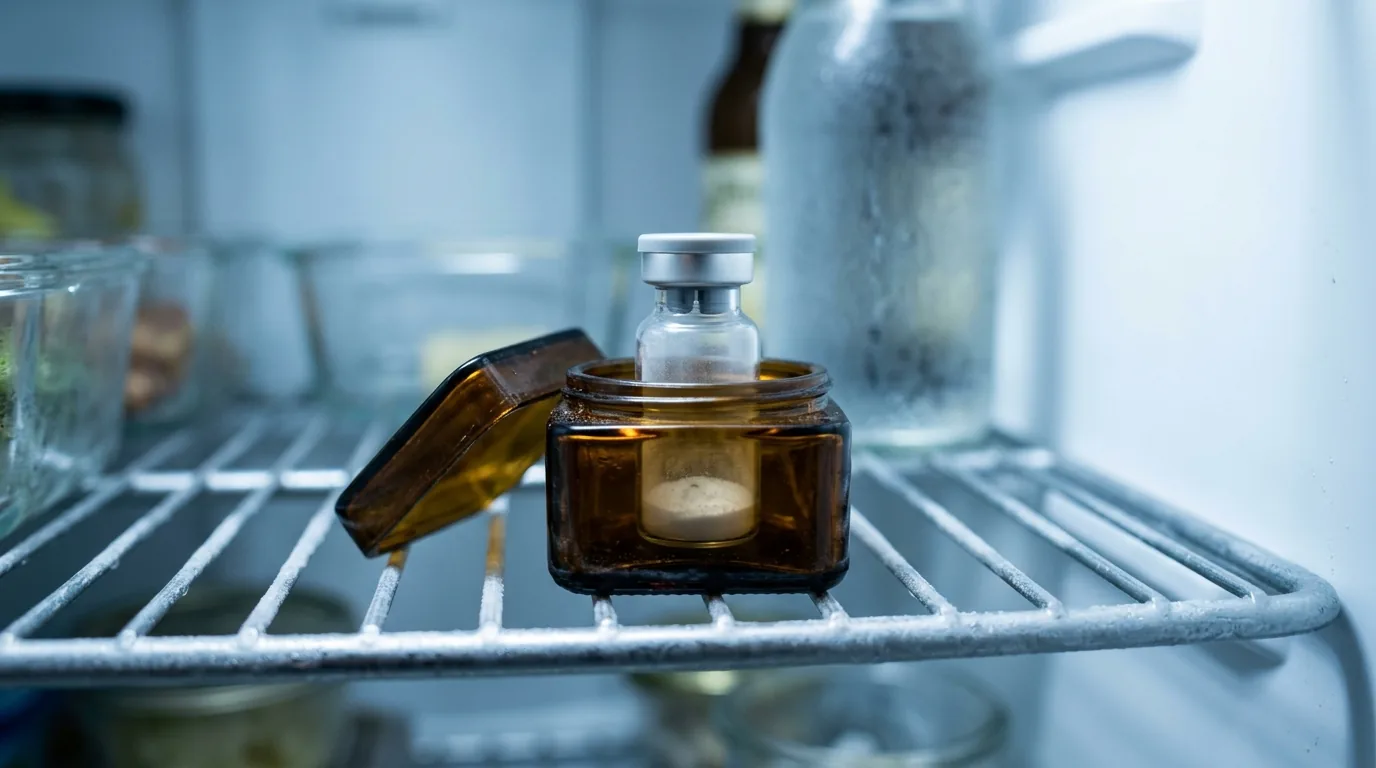
Two environmental factors degrade peptides faster than time alone:
- UV light. Specifically the higher-energy part of the sun’s spectrum, which can break peptide bonds and modify amino acid side chains (especially tryptophan, tyrosine, methionine). Indoor incandescent and LED light contains negligible UV — the practical concern is direct sunlight or proximity to a window.
- Heat. Above ~30°C (86°F), denaturation accelerates measurably; above ~40°C, it accelerates a lot. Heat is the bigger day-to-day problem for most users (a hot car, a counter near the stove, a closed mailbox in summer).
Practical implications: keep peptides in the fridge; if shipping, prefer cold-pack shipping; on receipt, refrigerate within hours, not days; never leave a vial in direct sun or in a vehicle in summer.
After reconstitution — 4 to 6 weeks of efficacy
Once you add BAC water (or saline) to the vial, the clock starts. The general guideline:
- Refrigerated, BAC-water reconstituted: 4–6 weeks of usable efficacy for most peptides.
- Refrigerated, sterile-saline reconstituted: roughly 2–4 weeks. Saline lacks the bacteriostatic preservative.
- Frozen reconstituted solutions: generally not recommended. The freeze-thaw cycle damages the dissolved peptide.
- Specific exceptions: some peptides (highly unstable ones) lose efficacy within days even refrigerated; others (highly stable ones like the GLP-1 class) are stable longer. The 4–6 week guideline is a sensible default; check the individual peptide’s library entry for any specifics.
An important framing — peptides don’t “go bad,” they lose efficacy
A common misconception is that an old peptide vial isdangerous. With proper sterile reconstitution and refrigerated storage, that’s typically not the failure mode. What actually happens:
- The active peptide molecules gradually break down — bonds cleave, side chains oxidize. The result is a mixture of intact peptide and inactive fragments.
- The bacteriostatic agent in BAC water (0.9% benzyl alcohol) actively suppresses microbial growth, so contamination is rare in a properly-handled vial.
- The practical result: the dose you’re drawing has progressively less active peptide in it. You’re underdosing without realizing it.
That said: if you suspect contamination (cloudy solution, particulates, change in color or smell, vial stopper compromised, exposure to extreme heat), discard the vial. The risk math is not worth it. “Doesn’t actively spoil” is not the same as “guaranteed sterile forever.”
Visible signs to watch for
- Cloudiness or particulates in a previously clear solution — discard.
- Color change (yellowing, browning) — discard.
- Compromised stopper (visible cracks, lifted segment, leakage) — discard.
- Lyophilized vial that’s no longer a fluffy pellet (fused into a glassy mass, melted appearance, moisture inside the vial) — was likely heat-damaged. Discard.
- Past the 4–6 week reconstituted window without meaningful effect — the peptide is likely still clean but underpotent. Discard and reconstitute fresh.
Practical storage routine
- On receipt: refrigerate within hours.
- Until reconstitution: back of the fridge, still in original vial, in the original box if available (the cardboard adds light protection).
- On reconstitution: write the reconstitution date on the vial (a fine-tip permanent marker on the label, or a small piece of tape). Trust the date, not your memory.
- During use: back of the fridge between doses. Don’t leave on a counter even briefly.
- At ~4–6 weeks post-reconstitution: discard and start fresh, even if there’s liquid left. The underpotent dose math isn’t worth the savings.
Reminder: Juno is a harm-reduction reference. The information above is general best practice for peptide storage; individual products may have specific instructions on the label that override these defaults. Your clinician or compounding pharmacist is the right authority on product-specific shelf life.