What you need to gather
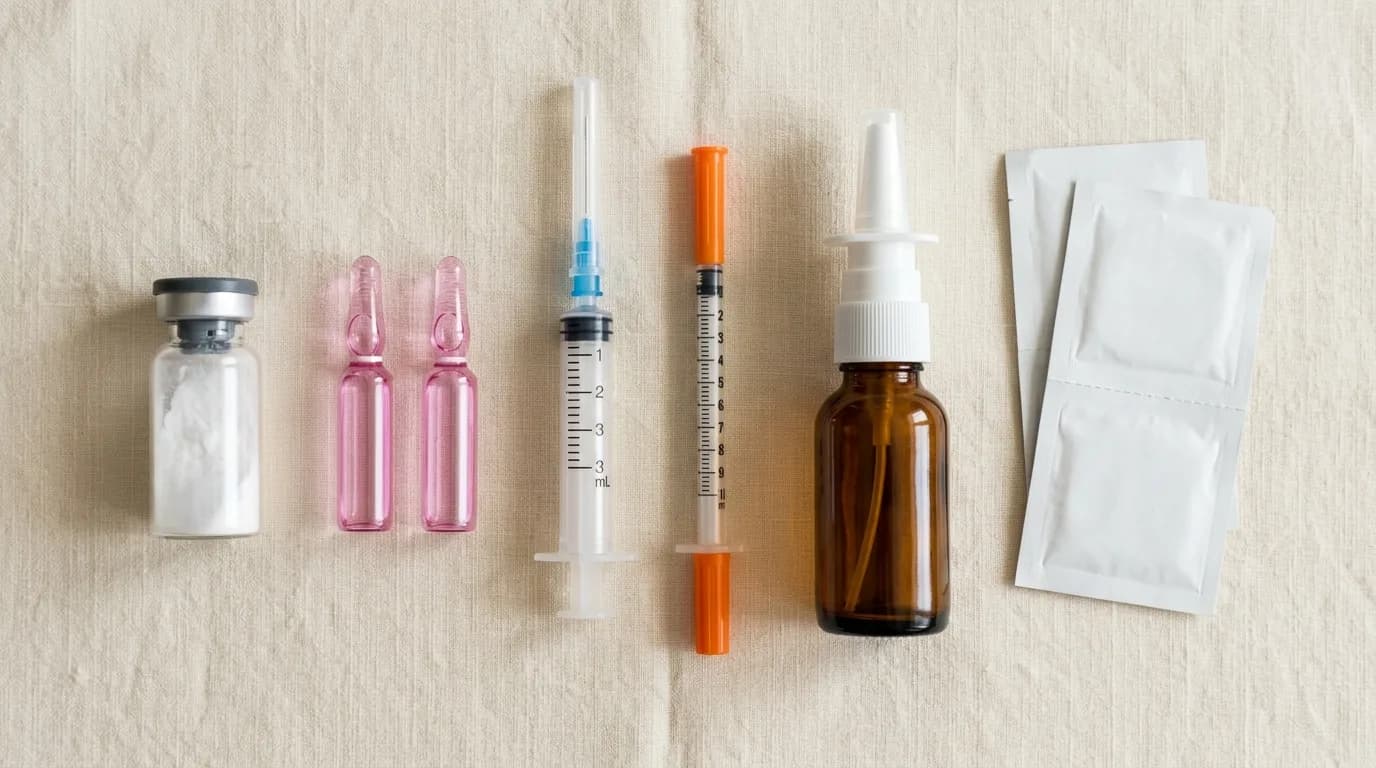
- The lyophilized peptide vial.
- Bacteriostatic water (BAC water — sterile water with 0.9% benzyl alcohol). Used to reconstitute the vial.
- Sterile 0.9% saline — preservative-free single-dose ampules are the cleanest option (sold for nasal irrigation and contact lens use).
- An empty nasal-spray bottle (5–15 mL is typical). New, sterile, with a 0.1 mL pump. Single-user device — never share.
- A 3 mL Luer-lock syringe with a 25–27G draw needle for the BAC water transfer, plus an insulin syringe for measuring the stock. (See the syringe guide for why one big draw protects the stopper.)
- Alcohol pads for sterilizing surfaces.
- A clean, well-lit work surface.
Step 1 — Reconstitute the vial in BAC water
Same procedure as a SubQ peptide: alcohol-pad the vial stopper, draw your BAC water with a 3 mL syringe + draw needle, and dispense it down the inside wall of the vial — not directly onto the powder. Swirl gently; do not shake.
Open the full reconstitution guide → for the complete walkthrough with sterile-technique detail.
Why BAC water for the vial. The 0.9% benzyl alcohol is a bacteriostatic preservative — it keeps the peptide stable in the fridge across many withdrawals as you periodically refill the spray bottle. Plain sterile water has no preservative; the stock would spoil faster.
Step 2 — Decide the spray-bottle ratio
This is where the two-stage idea pays off. The math:
- Stock concentration = peptide content ÷ BAC water added.
- Final spray concentration = (stock transferred × stock concentration) ÷ (stock transferred + saline added).
- Each spray = 0.1 mL as a standard assumption — verify on your bottle’s spec sheet (clinical and consumer pumps are almost always 0.1 mL).
Example: a 10 mg vial reconstituted with 2 mL of BAC water gives a 5 mg/mL stock. Transfer 1 mL of that stock into a nasal bottle and add 9 mL of saline → 0.5 mg/mL final → 50 mcg per pump. So a 100 mcg dose is 2 pumps; the 10 mL bottle holds ~100 pumps = 50 doses.
Open the nasal-spray calculator → to plug in your numbers — it surfaces edge cases (residual BAC % too high, dose under one pump, >4 pumps per dose).
Why mostly saline. 0.9% sodium chloride is isotonic with nasal mucosa and pH-friendly. BAC water is fine in the vial but irritating directly on the mucosa. By making the bottle saline-dominant (typical ratio: ~1 part stock to 9 parts saline), the residual benzyl alcohol in the spray drops to a small fraction of a percent — well below the threshold most users find irritating.
Step 3 — Build the spray bottle
- Wipe the vial stopper and the nasal bottle’s opening with fresh alcohol pads.
- Open a single-dose saline ampule. Draw the planned saline volume into a clean syringe and dispense it directly into the empty nasal bottle.
- With an insulin syringe, draw the planned volume of stock from the vial. Dispense it into the nasal bottle on top of the saline.
- Cap the bottle. Invert gently 5–10 times to mix. Do not shake — peptides are surfactant-sensitive and shaking creates foam that can denature them.
- Label the bottle: peptide name, mg/mL, mcg/pump, the date, and your initials. A piece of masking tape and a permanent marker is fine.
Step 4 — Prime the pump
A fresh nasal pump has air in it. Spray several pumps into a tissue until you see a fine, even mist coming out consistently. The first 3–6 pumps are typically air or partial liquid — they don’t deliver a full dose.
If the bottle sits unused for more than a week, re-prime with 1–2 pumps before your next dose to clear any settled liquid from the dip tube.
Step 5 — Take your first dose
- Blow your nose gently before dosing — clear mucus blocks the spray from reaching the mucosa.
- Tilt your head slightly forward, not back. This keeps the spray on the absorbing tissue rather than running down your throat (where it won’t absorb and just tastes bad).
- Insert the nozzle into one nostril. Close the other nostril with a finger.
- Sniff gently while pumping. Do not inhale hard — that pulls the spray past the absorption zone and into the throat.
- Pump the prescribed number of times into the nostril, pause, then repeat in the other nostril if your dose calls for it.
- Wipe the nozzle with a tissue. Cap the bottle. Don’t blow your nose for at least 15 minutes.
Step 6 — Rotate nostrils across doses
Each nostril’s mucosa needs recovery time. If your dose is 2 pumps total, that’s 1 per nostril. If it’s 1 pump, alternate nostrils across doses (left in the morning, right in the evening). Chronic single-nostril dosing causes local irritation and uneven absorption.
Step 7 — Store between doses
Cap tightly. Store the spray bottle refrigerated and away from light. The same shelf life applies as any reconstituted peptide — typically 4–6 weeks of efficacy. After that, build a fresh bottle from the stock vial.
Open the storage & shelf-life guide →
What to watch for
- Persistent stinging or burning after dosing — likely too much residual BAC in the bottle. Re-check the calculator; consider rebuilding with more saline / less stock.
- Dripping out the nostril — head was tilted too far back, or you sniffed too hard. Re-read step 5.
- No noticeable mist — pump needs re-priming or the dip tube is clogged. Replace the bottle.
- Cloudiness or particulates in the bottle — throw it out. Build a fresh bottle from the stock vial.
Reminder: Juno is an educational reference. Nasal administration of peptides is mostly community practice; published evidence varies by molecule. Talk to a qualified clinician — ideally one familiar with the specific peptide — before adopting a nasal protocol.