Before you start: what you actually have
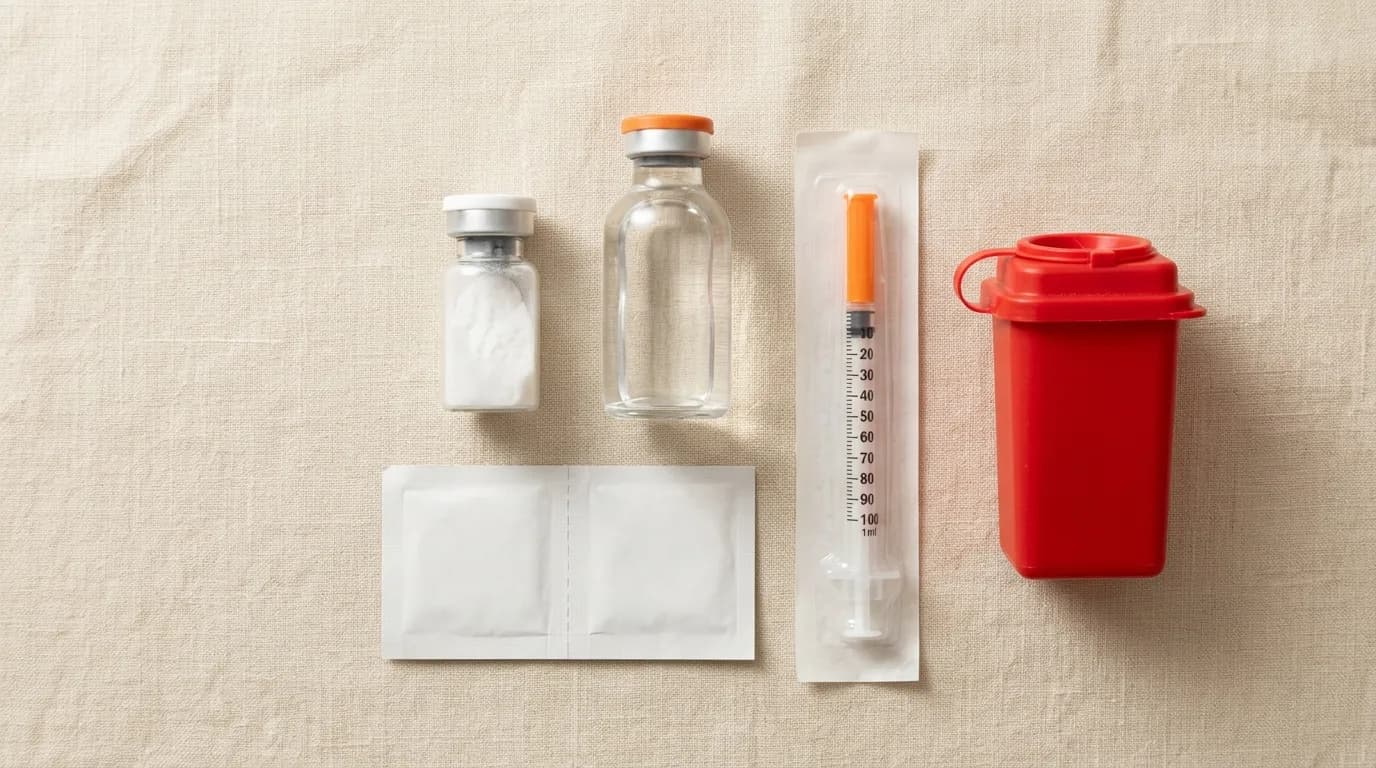
Inside the sealed glass vial is a small amount of fluffy white powder. That’s the peptide, freeze-dried for shelf stability. The powder is not active until water is added — it’s inert dust as long as the vial is sealed.
Put it in your fridge. It’ll keep for a year or more this way. (See storage & shelf life if you want the full temperature spec.)
What you need to gather
Before you do anything else, get the supplies. You can order all of these from a single online vendor.
- 1Bacteriostatic water (BAC water) — sterile water with 0.9% benzyl alcohol. Slows microbial growth so your reconstituted vial lasts weeks. Sold in 10–30 mL multi-dose vials.
- 2One 3 mL syringe with a thin draw needle — for reconstitution only. Used once, then discarded.
- 3Insulin syringes (U-30, U-50, or U-100) with 30G or 31G × 5/16" or 1/2" needles — for actual daily / weekly dosing. One fresh syringe per dose.
- 4Alcohol prep pads — the small individual sachets. For wiping the vial septum and the injection site.
- 5A sharps container — hard-walled, puncture-resistant. Don’t put used needles in regular trash.
For the full reasoning behind each item — gauge, length, sterilization markings, why a 3 mL syringe for reconstitution — read Syringes & needles →
Step 1 — Plan your dose
Before you mix anything, work out the math. You want to know: how much BAC water to add, and how many units that translates to per dose. The peptide calculator does this for you in 30 seconds. Punch in:
- Vial size in mg (read it off the label)
- BAC water you plan to add (typical: 1–3 mL)
- Your target dose in mcg (read it off the peptide’s library entry)
- Which syringe size you have on hand
The calculator gives you the exact units to draw on your insulin syringe. Write the number down. The first time it’s the most important number; after that you’ll remember.
Step 2 — Reconstitute (just once, carefully)
This is the only-time-you-do-it step. You’re moving the BAC water from its vial into the peptide vial.
- Wash your hands.
- Wipe both vial septums (the rubber tops) with alcohol prep pads. Let dry ~5 seconds.
- Draw the BAC water into your 3 mL syringe.
- Inject the BAC water into the peptide vial — but slowly, against the side of the glass, not directly onto the powder. Aggressive force can denature the peptide.
- Withdraw the empty 3 mL syringe. Don’t shake the vial. Gently swirl, or just leave it on the counter for 30 seconds — the peptide will dissolve on its own.
- Write today’s date on the vial label with a permanent marker. The clock starts now: 4–6 weeks of usable efficacy.
For the step-by-step interactive walkthrough with photos and sterile-technique callouts, open the reconstitution guide.
Step 3 — Pick your injection site
Almost every peptide here is dosed subcutaneously — into the fat layer just under the skin, not into muscle. The most common sites, in order of community preference:
Below the navel, off to either side. Easiest to access yourself.
Middle third of the side of the thigh. Easy when sitting.
More fat in most adults; usually needs a partner to inject.
Back of the upper arm. Hard to self-inject without help.
The most important rule: rotate. Don’t inject the same square inch two days running. Move at least an inch from your last injection site.
For technique details (pinch the skin? what angle? what counts as a normal reaction vs. something to call your clinician about?) → read injection locations & technique.
Step 4 — Inject
This is the moment that scares people. It’s also the shortest moment in this whole process.
- Wipe the peptide vial septum with alcohol. Let dry.
- Wipe the injection site with alcohol. Let dry.
- Draw your dose into a fresh insulin syringe. Pull the plunger back to your dose volume FIRST (loading air into the barrel), then insert the needle through the vial stopper, push the plunger down to inject the air, invert the vial, and pull the plunger back to your dose mark to draw the liquid. Without the air-equalization step the vial fights you on the plunger. Full draw-technique walkthrough →
- Tap the syringe to bring any small bubbles to the top, then push them back into the vial with a tiny plunger nudge. Re-draw to your exact dose mark.
- Pinch a roll of skin/fat at the injection site to lift it away from underlying tissue.
- Insert the needle at 45–90° depending on how thick the pinched fold is. Insulin syringes are short; you can’t easily go too deep.
- Push the plunger down steadily. Count to 3.
- Withdraw the needle, release the pinch, press the alcohol pad on the spot for a few seconds.
- Drop the used syringe in your sharps container.
Step 5 — Track it
Open your stack and add this peptide. Set the dose, the days you plan to take it, and how many vials you have on hand. The stack will tell you when you’re running low and remember what you took on which day.
This is the difference between “doing peptides” and “running a protocol.” Tracking lets you correlate dose changes with how you feel, and lets you reorder before you’re out.
Step 6 — Ask questions
Every peptide’s library entry has a chat box at the top of the page. Ask about timing, side effects, stacking, anything. Answers come in two clearly-labeled parts: research-grounded (cited from the literature) and community practice (anecdotal experience, also useful but explicitly uncited). The disclosure is up front so you can weigh each.
Browse the peptide library for the full evidence-tiered list.
What to do after your first dose
- Watch the injection site for 30 minutes. Some redness or a small bump is normal. Spreading redness or hives — call your clinician.
- Watch how you feel for 24 hours. Some peptides have immediate effects (GI side effects from GLP-1s, sleep changes from GH-axis peptides); some have effects you only notice over weeks.
- Log the dose on your stack so you don’t lose track.
- Put the vial back in the fridge. Don’t leave it on the counter.
What you read next
Calculator
Dose math — vial mg, BAC water, target mcg → exact units.
Reconstitution walkthrough
Step-by-step interactive guide for the mixing process.
Syringes & needles
Gauge, length, capacity, sterilization markings, the reconstitution-syringe trick.
Injection locations
SubQ sites, rotation patterns, sterile technique, what's a normal reaction.
Storage & shelf life
Temperature ranges, lyophilization, the 4–6 week reconstituted window.
Nasal sprays
Which peptides are nasally absorbable, saline as the vehicle, 0.1 mL pumps.
A reminder. Juno is a harm-reduction reference. The plain-language framing above is meant to take fear out of the process; it’s not meant to replace a conversation with a clinician about whether a specific peptide is right for you. Especially the first time, consider talking to a doctor familiar with peptide protocols.